Quote

"Keep working on a plan. Make no little plans. Make the biggest you can think of, and spend the rest of your life carrying it out." Harry S. Truman
Showing posts with label The Multicultural Life. Show all posts

Wednesday, October 20, 2010

And where do you think my children have lived all their young years?


Never would it occur to me to carry anything on my head. It doesn't matter that I have also lived the past ten years (and counting) between Nigeria, India and now Bangladesh, where this is the normal way of carrying most anything. But for them, it is the most natural thing to do.

Tuesday, October 12, 2010

The Virtual Tour for Kelly Starling Lyon's "One Million Men and Me"

A few weeks back, Kelly Starling Lyons sent me an email asking if I would like to participate in her virtual tour on the occasion of the 15th anniversary of the Million Man March (October 16) - which was the inspiration for her picture book, One Million Men and Me. I was thrilled, of course. Not only do I like Kelly and her writing, this also falls perfectly into my continuing commitment to bridge the world.

We had to overcome a few challenges : first, I needed to get the book, and as I'm told that postal services cannot be trusted, here, it meant asking a friend at UNICEF headquarters in New York to send it by the pouch, and hope it would get here on time... Which it did.  But when I opened the envelope, the book inside was wet and quite damaged. I had to very slowly peel off the pages glued together and set them under the fan to dry (my hair dryer is in the container, with the rest of our personal effects). The bottom of many of Peter Ambush's expressive illustrations had suffered, but at least, the text was complete.

I had also hoped to involve the library at the American International School of Dhaka, but it proved impossible - this I found out only a few days before my post was due. In the end, I invited our daughters' new friends, and we read the book together in our empty, very echoing apartment.

The group was composed of girls aged 6 to 10, all from mixed backgrounds (France, Haiti, Indonesia and the US), and kids who've all already lived in at least two countries, spanning several continents. We talked about the beautiful illustration on the cover, and the Million Man March. After I read the book, we looked at pictures of the March on the Internet, and also discussed the March on Washington for Freedom and Jobs, on August 28, 1963, the civil rights struggle, and Martin Luther King Junior's historical speech. It was the perfect end to an extremely gloomy, rainy day in Dhaka, Bangladesh.

When I asked the girls what they had preferred in the book, they all mentioned the illustration with the African princess. One of them also said : "the first page, when the cousin said that no girls can go, but her daddy took her anyway." And she nodded, as if to say : there.

One Million Men and Me takes us back to that magical day, allowing us to experience it through the eyes of young Nia. We feel her pride, and we feel her joy, as she shares this very special moment with her father. She will never forget it, and nor will all the girls who read the book, I bet.

Thank you, Kelly, for this opportunity to discover and share your (and Peter Ambush) very touching book about not only the day when "Black men made history," but also the beauty and importance of the special bond between father and daughter (two daddies attended the reading, by the way, and my husband took the pictures.)

Anyone who posts a comment, here, or on Kelly's Facebook page or her blog, will be entered in a drawing for one of three prizes - One Million Men and Me T-shirt, tote bag or signed poster. Kelly will announce the winners on the March anniversary, October 16.


Monday, August 23, 2010

New country, new background, and first impressions.


The last two weeks were spent mostly in the Unicef car, fighting the grueling Dhaka traffic, and visiting big, empty spaces while trying to picture our furniture, and our lives in them. The process was rendered even more difficult by the fact that I fell madly in love with an apartment endowed with the most spectacular view (see picture), but, alas! one unredeemable flaw : they are building two apartment complexes on the next plot, and the construction will most likely last two years... Bye, bye, beautiful view ! Thing is, everything I saw after that felt like "yeah, bof !" But I've now come back to my senses, and settled for an apartment without a fantastic view, but offering other precious commodities : location, a minimum of greenery, space, generator backing, etc. We hope to move in by mid-September. Our shipment is due to arrive a few days later, same for the car. So, all in all, we hope to return to a regular routine by the end of September, and I'll then be able to go back to work, writing, blogging, etc. It will not be a moment too soon. All in all, we've been living out of our suitcases for almost three months, now.

My first impressions of Dhaka? It is interesting to be living in a predominantly Muslim country. In Nigeria, we were in the South-Eastern part, which is heavily Christian. As for Hyderabad, it used to be a state ruled by the Nizams, and the old city remains Muslim, but the vast majority of people are Hindus.

We arrived in Bangladesh during Ramadan, and right now, we're told that everything is geared up toward the upcoming Eid Festival - shops have shorter hours, and at the same time, businesses are open on days when they're usually closed (Fridays) because this is the time when people shop madly to give presents for Eid. Everything is a little slow because people are fasting. The other day, as we came out of one apartment, we saw a gathering of men seating on mats on the floor around small piles of food. It was all the building maintenance people, the drivers, etc, breaking the fast together - that first meal is called Iftar. We are also told that even though the poverty in Bangladesh is crushing, the begging at the moment is worse than usual, because of Ramadan. This is the time when people are supposed to give to the poor. Finally, the traffic is like nothing I've ever experienced before (except maybe Lagos, when we happened to go there). Hyderabad was bad at certain hours of the day, but overall, one got around. And it will get worse, as children are out of school at the moment. I'm not looking forward to that.

That's it for today. More to come, as we slowly settle in.

Wednesday, April 14, 2010

Varanasi : Hidden Temple


On the last afternoon, we were looking for a place to have lunch and spotted what looked like a pretty outdoor restaurant inside what must have been an old haveli at some point in time. We hopped off our rickshaw and went in. The restaurant was pretty, but the food was more than average, and I suspect it's what I ate there that was responsible for my not feeling well, the following day. Should have stuck to the street side stalls selling chaat. Anyway, inside that open area was the most beautiful little temple, built apparently by some maharajah who still comes to visit once a year. Look at that beauty.

Saturday, April 10, 2010

Varanasi : Morning rituals along the Ganga

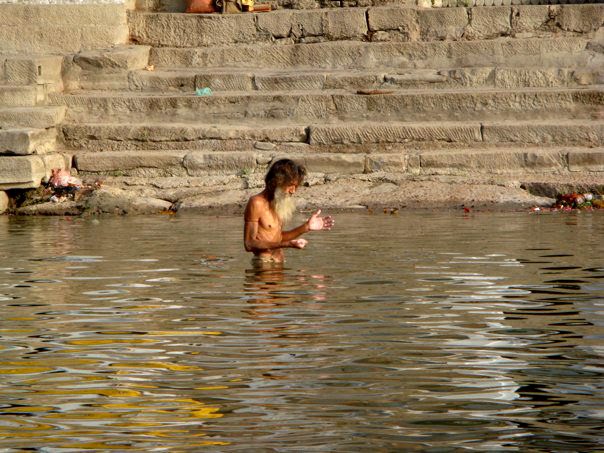
The absolute highlight of my visit to Varanasi was the morning boat ride on the Ganga, right after sunrise.

The light was sublime, the air carried a lovely fresh breeze, and being on the river, with the sound of the oar parting the water as we glided along the ghats watching the morning rituals, was magic. As soon as it was over, I wanted to do it again. Unfortunately, I was not feeling well the following morning (and last), and could not renew the experience. No matter, I took dozens of pictures, and the images are still vivid in my mind.


Here we see a man mediating against a backdrop of collapsed temples half immersed in the water.
Our boat-wallah had an explanation about this : a pandit was meditating on this ghat and asked to move so a temple could be built. When he wouldn't, he was forced to. Furious, he declared that no temple would ever stand straight on these steps. (It is a very similar story to the story of the Mehrangarh Fort, in Jodhpur, as reported here.) My traveling guides simply mention that the elaborate structures of that temple were so heavy that they collapsed. That ghat  is eerily beautiful.


A family taking a dip, and waving happily.

Below, pandits performing a puja on a little platform complete with umbrella, on the water.

Friday, April 9, 2010

Varanasi : Offering to the Ganga


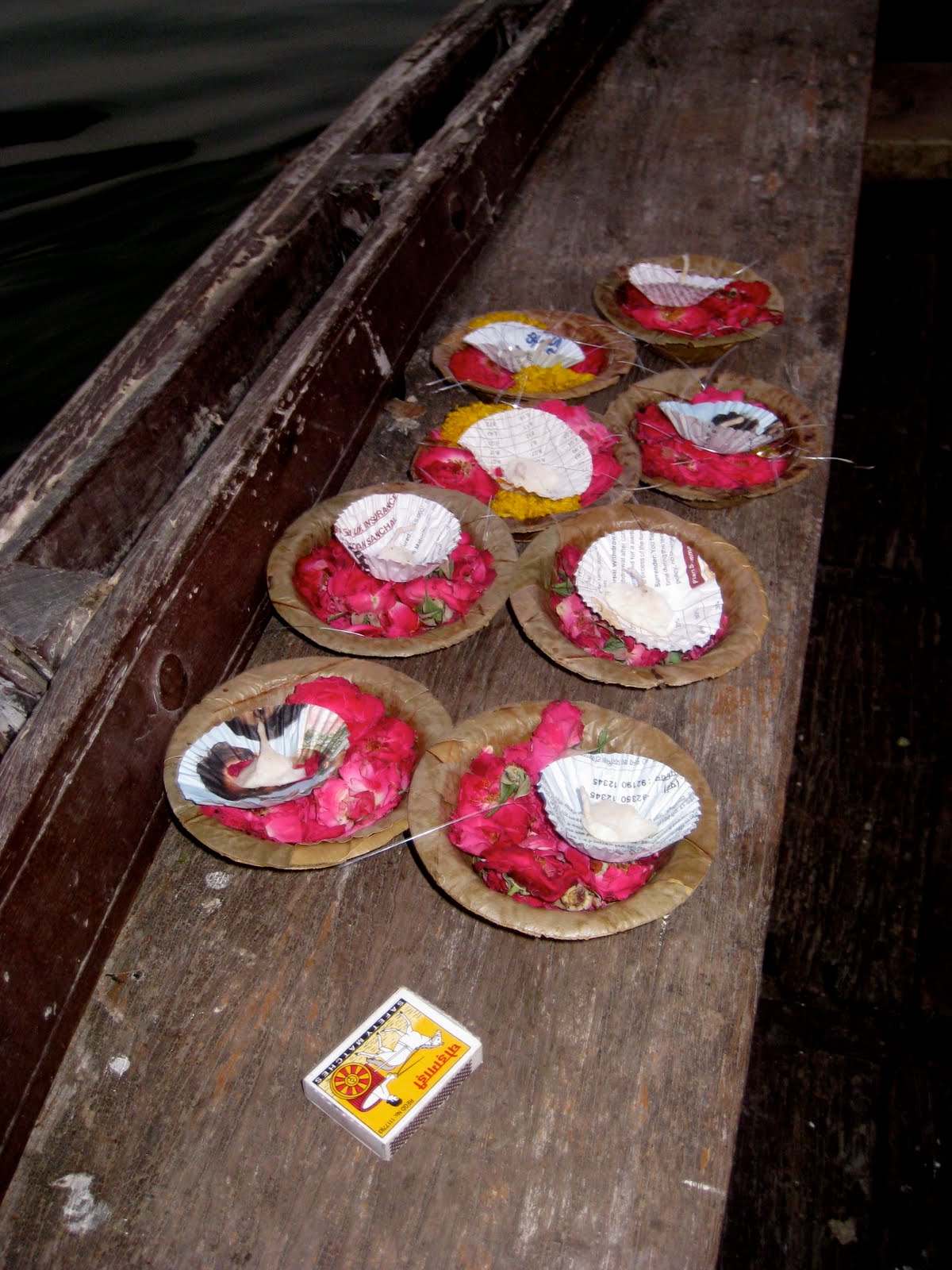
During our evening boat ride, we bought diyas to this little girl I mentioned before, and offered them to the Ganga.

I bought four of these little recycled paper cups filled with petals that the girl probably picked up from some seller at the end of the day, or who knows where as they looked extremely tired. Each had a wick and some wax in the middle. One for each member of my family. You are supposed to have a thought, or wish, as you do this.

My friend is a widow with two grown-up sons, and she also offered four diyas to the Ganga. Interestingly, the first one capsized almost immediately.

As she looked at my little diyas moving with the current, she commented on the first one moving much faster than the others, and said : "Here goes Michel, way ahead of everyone else." I started looking at this little group of diyas. She was right. One kept on moving ahead, two were very close together, and one seemed to hover on the side, not too close, but not too far either. I like to think that it was my diya, and the others were my daughters.


Thursday, April 8, 2010

Varanasi : Buying Sarees

So far, my experience buying sarees had been limited to going thrice to some of the big shops in Hyderabad. You go in, sit on a chair in front of a long table, and a salesman gets sarees out one after the other.

In Varanasi, thanks to my friend and her numerous connexions all over India, I discovered a new way of shopping for sarees.

First, you take off your shoes and enter a big room where the whole floor is covered with white mattresses. You sit against bolster cushions, drink chai or sweet-and-salt lime water, and a man brings saree after saree after saree until the mattresses around you have beautiful piles shimmering with bright colored silks.

The salesman will even model the saree for you, as seen below.

And yes, I brought two home... Souvenirs, you know.

Wednesday, April 7, 2010

Varanasi : People


One of the highlights of Varanasi was the warmth of its people. I had read in some guides that tourists get pestered a lot, and having experienced that in other places in India, I expected to have to say, and repeat, and repeat again a lot of "no, thank you." Well it didn't happen, even when I went off on my own along the ghats or in the lanes of Varanasi.  I was greeted by a lot of "Namaste" and that was about it.

Above are two ladies sitting outside their home, chatting, and watching the world go by.

Below,  is a family having lunch.


Young people having fun in the water.


After a few days on the ghats, you start recognizing faces. We kept seeing this girl. Here she's selling us diyas to offer to the Ganga.

And finally, one of our rickshaw wallahs.

Monday, April 5, 2010

Varanasi : Lassi, Chaat

As mentioned in the first post of this Varanasi series, one of the things that made this trip so different for me was that I didn't have to be as careful as I usually am when traveling with the children (and my extremely hygiene-conscious husband.) I won't say I didn't experience some trepidation as I sampled some of the Indian staples sold in the street, because I did. But oh well !

Our breakfast, each morning, was lassi, which is a yogurt based drink. One on the first day, two on the following, because it was so incredibly yummy. Eating it out of the little clay pots is not easy, but it's part of the fun.

Of course, I then realized that the clay pots cannot be recycled, which is why you see piles of broken earthware in so many places. Better than plastic, I suppose.

Another new experience was eating Chaat. I'd had some here in Hyderabad, before, but in a mall. Now, I realize that the dish on the picture may not look like much, but trust me : it was absolutely delicious, and for someone who's been living in Andhra Pradesh, known to have one of the hottest food in India, pleasantly mild !


Friday, April 2, 2010

Varanasi


I just returned from a 6 days trip to Varanasi, often referred to as the holiest city in India, or the City of Lights. It was a great experience in so many ways. I traveled with an Indian lady, someone I met briefly at a wedding, in Hyderabad, two years ago, and then saw again, once, in Delhi where she was my guide in the lanes of the old city. In other words, we were virtual strangers to each other. Six days later, I feel that I've made a new friend.

Of course, it was extremely different from traveling with my husband and children, a bunch of foreigners staying in hotels usually ranging from very nice to luxurious, and eating breakfast and dinner in them too, as it is so much easier to be on the spot at the beginning and the end of a touring day: kids can eat familiar and safe food, and have their bath before we tuck them in at night.

Both my friend and I were adamant about staying on the ghats, as opposed to the Cantonment where the nicest hotels are. This means that what you pay for is basically the view. Careful research on the internet and trusted guides like the Lonely Planet yielded only half a dozen suitable places, and the preferred ones were full. We ended up at the Sita Guest House, on Rana Ghat, and the experience reminded me of my old backpacking days, when I toured South East Asia on a 5 dollars a day budget. But the place was clean, and when the electricity worked (Varanasi has power cuts everyday from 1 to 3 PM, and most of the time from 4 to 5 PM, with a few surprises thrown in) we even had A/C - most necessary, as the average temperature during our stay was 100 degrees F. and up (39 Celsius).

My friend Sangeeta, who is the type of person who makes friends the second she arrives somewhere (funny, as my husband is like that ; I'm much more reserved by nature) met a young pandit who offered to take us to the main temples in town. Contrary to me, whose agenda was basically to visit this famous city, look, look, make notes, and soak in the atmosphere, Sangeeta had a carefully planned program that included visits to a list of temples, and buying sarees (Vanarasi is known as one of the best places in India for sarees). I'm glad to report that we both more than fulfilled our expectations.

Here are a few pictures. More posts to come...

The arrival. After almost six years in India, I've grown accustomed to the fact that the country is the second most populated in the world. But Varanasi is something else. Even my friend was stunned by the swarms of people, vehicles (cars, cycle-rickshaws, auto-rickshaws, old tongas pulled by buffaloes, bicycles) and animals (cows, more buffaloes, horses, goats, dogs) filling the streets and lanes of what feels basically like an overgrown village.


My first glimpse of the river Ganga.

Thursday, March 25, 2010

The beauty of our expat life

On Tuesday night, our daughters' school had their annual stage production, and it was such a joy to see these children partake in a celebration that honored diverse cultures.

The children were awesome, their costumes absolutely stunning, and as I watched my daughter sing a song in Hindi, then play a piano piece from American composer William Gillock, and finally perform an Indian folk dance, I thought about how lucky our Third Culture Kids are to be able to sample the world in this way.

Of course, being an expat has its downsides and heartbreaks, and it's always good, and even necessary to be aware of them, but the breadth of these children's experiences and exposure is something that needs to be celebrated as well. Today's post is an expression of gratitude for the richness of our very colorful life.


Very blurry picture above, because it's not a picture, but a short movie. Unfortunately, I have not been able to upload it. Not quite the tech wizard, me...

Posted by Picasa

Thursday, March 4, 2010

Happy Holi !


Holi, the festival of colors, marks the end of winter, and is celebrated by throwing colored water and powders at everyone. This year, it was on Monday March 1, and as I type these words, I look at my still very purple fingers, and remember the jolly good time we had.

Here is how to celebrate Holi in 3 easy steps...

1/ To begin, search the town for natural colored powders (an organic store is a good bet.) They come in five colors only : red, blue, green, orange and yellow, while the synthetic ones come in bright pink, purple, etc, and are sold everywhere in the streets. But careful, as some can be toxic.

(I bought a few extra boxes for next year, in case we end up in a place where they don't know about Holi...)

2/ Before you leave home, do cover yourself in oil. Do not forget your hair!

3/ Finally, get several buckets, and fill them with water. If you really mean business, purchase a few water guns (some of those actually looked like really mean war machines, only in plastic.)

Ready ?

Here we go... And whenever you drench someone in water or throw colored powder at them, don't forget to scream HAPPY HOLI !


P.S: Afterwards, spend two hours in the shower scrubbing, scrubbing, and scrubbing until your skin is raw, and watch all the colors rushing down the drain... Discard ruined clothes. Spend a week walking around with green and pink streaks in your hair and exchange knowing smiles with people whose whole neck or side of the face is still bright pink... Who cares? It was FUN !

Wednesday, February 24, 2010

Body language

OK, let's start this post with a confession - and believe you me, I'm not proud of that : I have not learned to speak Hindi (or Telugu, or Urdu, or Sanskrit). I have some excuses, I suppose. Never did we imagine we'd end up spending six years in India, and counting. Also, when we first arrived, I had a six-weeks old baby, so on top of all the adjustments of the first year's culture shock, not to mention work, and writing, I was kind of busy with the little one, and with the big one, who also had to adjust to living in a new country, going to a new school, etc, AND having a new, very noisy, and demanding little person in the family. Plus, which one of the above-mentioned languages to learn ?

Of course, after all this time, I've actually integrated a lot of everyday words into my vocabulary. I no longer ask for flour, I ask for maida. I don't use a broom, I use a jhaadu, etc. But I'll be honest : that's about it.

One thing I've learned, though, is the South Indian body language. So much so that before going home, last summer, I imagined my friends and family would laugh themselves silly just looking at me.

One of the things that strike foreigners when they arrive in this part of the world is the way people use their head. Nodding to say "yes," and head-shaking to say "no" is pretty universal. But Indians have invented a third way, with the head wobbling from right to left, the right ear going a bit closer to the right shoulder, and then the left ear closer to the left shoulder, to be repeated once or twice. What does it mean? Well, it depends. Basically, that the person agrees with you. But, you see, as it is considered rude to say "no" in India, people have come up with the solution of not saying "no" or "maybe" or "highly unlikely, but who knows? " without officially saying "yes." Brilliant, right ?

Yesterday, I parked the car to go to an ATM machine, but as I went up the steps to the small room next to the bank, I saw that the metal shutter was halfway down. I looked at the security guard sitting on a chair outside the door and rotated my hand from right to left, palm open, fingers spread, as if to say "not open?" The man said "Close," and we both wobbled our heads, secure in the fact that even though we do not speak a common language, we understood each other perfectly.  If you see me going to the shops, or talking to people (locals or expats) in India, you'll see me doing the head-wobbling thing, and lots of hand gestures. But the funny thing is, as soon as I land in another country, or deal with people who have nothing to do with India, the head-wobbling, and hand-rotating stop, and I go back to my boring pre-India body language. I guess it's a similar process to the one that made my children know, practically from the moment they could speak a few words, that I, their father, or the family in France or Haiti were to be spoken to in French, and everyone else around in English.

Here is a short video to illustrate the Yes or No head-wobbling dilemma that foreigners encounter when they first arrive in India. And just to put that poor guy's mind at rest : the young man is saying "yes," but that doesn't mean it will not turn out to have been a "no" all along.

Saturday, February 20, 2010

Our Life in India : Seeking Enlightenment in the Land of Spirituality


I'm not a religious person. Neither am I guru groupie material ! I was born and grew up in the land of Descartes, who said, among other things : "I think, therefore I am." In other words, rational thinking is everything, forget about God! I distanced myself from my Catholic upbringing (my mother is Spanish: need I say more?) as soon as I was able to articulate my own opinion (as opposed to going with the flow of the education I had received) and declared myself an atheist. I didn't know any alternative at the time, and being an atheist seemed the closest match to my state of mind.

Then, I travelled throughout South East Asia, and met someone who told me about the Buddhist Silent Meditation retreat at Suan Mokkh. It starts on the first day of each month, which happened to be the following day, and what do you know, I jumped in a bus, and soon found myself sitting on a tiny cushion listening to Thai Buddhist monks mumbling in barely understandable English. Complete silence was the rule, we ate two vegetarian meals a day, and spent the rest of the time meditating (sitting, standing, walking, chanting meditation.) Only, I could not meditate, and sitting cross-legged on that hard floor for hours on end was sheer torture. I couldn't sleep on the concrete bed of my tiny, Spartan (mm, Spartan or Buddhist?) cell, not to mention the throngs of mosquitoes buzzing around my mosquito net, and the tiny insects that passed through and landed on my face, my mouth... Agh! I lasted 5 days out of the 10, only because I found the talks each morning incredibly profound and thought provoking. So much so that I copied them in my traveling journal. So, when the talk on the sixth morning failed to inspire me, I went back to my cell, packed my bag, and hitch-hiked to Surathani, where I got into a ferry to Koh Samui to do a diving course.

Over the years, the Buddha's teachings always stayed with me, though. I love Buddha. And then, I went to live in New York, where I discovered the New Age movement. Suddenly, it dawned on me that organized religion and spirituality are not the same thing. I didn't need to practice a particular religion to feel a connexion with a Higher Power. Wow! That was a major breakthrough for me.

Fast-forward. For the past few years, we have lived in India, and witnessed, recorded, and sometimes partaken in Hindu celebrations. I'm continuously reading and learning about all the Hindu festivals and the many gods in the Hindu pantheon. And all the while, I have continued my own personal journey. So, when a local friend called to tell me about a meditation workshop happening in Hyderabad, I decided to give it a try, even though it meant being away from home and the kids for four entire days, including a week-end, from 9 am until 9 pm.

And ???

Well, I remain French in the sense that I cannot totally surrender, ever, to... anything or anyone, including a guru, however brilliant and inspiring he may be. That said, anyone who has the opportunity of listening and/or participating in a workshop with Paramahansa Nithyananda (Nithya means eternal in Sanskrit, and Ananda means bliss) should just drop everything else, and DO it ! (Be prepared to waste some time ; this workshop lasted 12/13 hours each day, but it could have easily been made shorter by at least 3 or 4 hours on practically every day, time that we wasted waiting for people to be all seated, coming back from extensively long lunch breaks, napping, having tea breaks, or waiting for Swamiji to read all the questions dropped in a box, even  though many of them were the same. Also, be prepared to overlook some of the statistics that he comes up with, as I didn't always find them very convincing. Finally, go there with a sincerely open mind. It is a leap of faith, and going with a mind set on criticizing, and finding fault will most certainly result in a total waste of money and time.)

Swamiji (the Hindu honorific title that everyone uses when talking about him or addressing him) is intensely bright - good thing for an enlightened Master, I know, but I, the writer, am having a hard time finding the right word to describe his acute intelligence, his clarity, and his gift for coming up with striking metaphors. Not only that, but he has a unique way of blending a decidedly traditional approach with a most modern mindset. He's very straightforward, in a way that is rarely seen or heard in India.

Examples: during one of the Q and A sessions, he told us that when a man comes to him during darshan (a blessing ceremony) asking for his blessing so his wife gives birth to a boy, he tells him to "get lost." He will give his blessing to someone who wants a child, not someone who wants a boy. Also, traditionally, women are banned from entering temples when they're menstruating. He doesn't believe in that. His take is that such rule may have been created to allow women to rest during those days when they are easily tired. He also feels that "tolerance" about other religions is not enough : there should be "mutual respect" between people of all faiths. Etc, etc.

One metaphor has stayed with me. He used it on the last day, as he explained to us the need to "un-clutch," or let go. In Northern India, they use a very simple device to catch birds. A rope is tied in the middle of a stick, and both ends of the rope attached to the branches of a tree. When a bird perches on one side of the stick, its weight makes it flip, and the bird finds itself head down. It seems that the bird then freezes. Because it is in a destabilizing position, a situation unknown to him, he clings to the stick for dear life, forgetting that it can simply fly away. The hunter only needs to come, and catches the bird. Whenever our comfort zone is disturbed, whenever we feel threatened, or unsure, we all tend to grip onto things, thoughts, people. That's our mind playing tricks on us, and telling us that if we let go, we will fall - like that bird. We don't realize that we only need to un-clutch, and we'll be able to fly.

A lot of what he says is common sense, based on the Vedic Culture. His meditation techniques are quite powerful, and he has a radiating presence. We were told repeatedly that he has healing powers. I wouldn't know about that. (My take would be, rather, that he has a way of helping people connect with their own positive energies so that they heal themselves, or rather, they stop destroying themselves.) But I did have my own intense experience with him, during the first darshan, and I have to admit that his reaction (our interaction lasted but one minute - there were 900 hundred people in that hall) had a strong impact on me. He made me think, he made me laugh, and he made me cry. He also managed to make me sit on a cotton mattress for hours on end, and even to meditate for more than one hour at a time!

Overall, a great experience !

Below are the few pictures that I took when I first arrived. Good thing, because after that, we were requested to not take any more photographs.


All the shoes left outside. I did worry about my sandals disappearing. The conference hall was inside a huge compound called Shilparamam and open to the public. I'm pleased to report that I always found them exactly where I'd left them.

Below: The conference hall. This was still early, so it's not full.


The workshop kit :
- An eye band used to cover our eyes during meditation. I confess that I peeked underneath from time to time. Come on !
- Two notebooks that were used to record all our engraved memories (physical, mental, and emotional pains, desires, guilt, etc.) On the last day, we ripped these pages and threw them away, along with an offering of flowers and some seeds which name I've forgotten. All these pages were supposed to be burned at the ashram, later. I would have liked to be able to throw them myself into the fire, but I can understand that it was not the most practical thing to organize.

Nithyanandam !